Nigerian Concord Newspaper
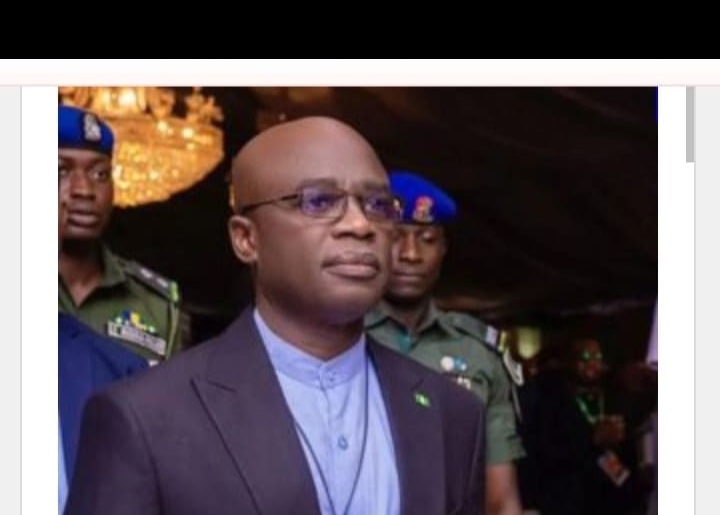
The Benue State chapter of the People’s Democratic Party, PDP has accused the state governor, Reverend Father Hyacinth Alia of non implementation of local government autonomy despite a clear presidential order that all state governors across the country should allow their respective local governments have their autonomy.
The main Benue’s opposition party also accused the government of Governor Hyacinth Alia of being on reverse gear, an action the party claimed has slowed down development in the state.
Making this known in a press statement this evening in, the State Publicity Secretary of the People’s Democratic Party, Bright Yima Antyo also berated the ill timing of the Economic Reform Team which the governor inaugurated few days ago.
According to the party in the statement, such team would have done better if it was inaugurated immediately the governor took over in 2023.
The statement reads below:
The Peoples Democratic Party (PDP) has watched with disbelief the latest actions of Governor Hyacinth Alia, which once again expose the huge gulf between his campaign promises and the reality of his administration.
While seeking the votes of Benue people in 2023, Governor Alia repeatedly promised to grant full autonomy to the 23 local government councils. Three years later, that promise remains unfulfilled.
Rather than freeing the councils from the grip of the state government, the Governor has chosen to tighten that grip by creating a full-fledged Ministry of Local Government and Chieftaincy Affairs, complete with a Commissioner.
This is a classic case of promising autonomy but delivering bureaucracy.
The question Nigerians and Benue people must ask is simple: How can local governments be autonomous when the state government continues to erect additional layers of control over them?
The Bureau for Local Government and Chieftaincy Affairs already exists. If the Governor genuinely believes in local government autonomy, the logical step would have been to dismantle structures that interfere with the independence of the councils, not elevate them into a bigger ministry with expanded political control and additional financial burden on taxpayers.
The consequences of this over-centralization have been devastating for governance at the grassroots. Nearly four years into the life of this administration, the 23 local government councils in Benue State have been reduced to mere ceremonial institutions, with little or nothing to show for the enormous allocations accruing to them. Across the state, there is hardly any evidence that the local governments exercise meaningful control over their own resources or development priorities.
In July 2024, Nigeria’s Supreme Court granted financial autonomy to the 774 local government councils in the country, ruling it unconstitutional for state governments to intercept council funds. The apex court’s verdict aimed to enable direct federal allocations to local governments. Governor Alia was one of the state governors who vigorously resisted the granting of financial autonomy to local governments and were only defeated at the Supreme Court. He has refused to implement the Supreme Court judgment even after President Bola Tinubu also gave a direct for the implementation. Local Government Chairmen in the state have been subjected to threats of removal and EFCC arrest, should they expose the stranglehold on their resources.
There is nothing like local autonomy in Benue State under Governor Alia. This is a sharp departure from when PDP was in power in the state and local governments had full access to their resources and were executing massive projects.
President Tinubu, only a few days ago, asked Nigerians to hold their governors accountable, because his administration is giving them five times more than what states were receiving before he assumed office in 2023. The President’s disclosure further confirms what many Nigerians know to be the fact, that the current crop of governors have no reason to owe salaries and pensions, and also not allow local governments have control of their funds.
Despite the enormous resources at its disposal, the Alia administration has deliberately refused to pay arrears of salaries, pensions and gratuities. It has also abandoned 22 out of the 23 local government areas of the state in terms of development projects.
Indeed, it is a sad commentary on the state of local governance that, in almost four years, not one of the 23 local governments can point to the construction of even a single public toilet, a culvert, or any modest community infrastructure executed from its own initiative. This paralysis is not accidental; it is the inevitable consequence of an arrangement that concentrates power and resources in the hands of Governor Alia while leaving the constitutionally recognized third tier of government financially and administratively emasculated.
The creation of a ministry to oversee local governments only reinforces this unhealthy stranglehold and further distances the councils from the autonomy Governor Alia solemnly promised the people of Benue.
This latest decision is nothing short of an official announcement that Governor Alia has abandoned his campaign promise on local government autonomy.
Even more appalling is the Governor’s inauguration of an Economic and Policy Advisory Team after spending more than three years in office.
An economic advisory team is not a retirement gift to an administration. It is one of the first structures a serious government establishes immediately after assuming office. It provides the intellectual direction, policy coordination and economic roadmap upon which governance is built.
Governor Alia has done the exact opposite.
After three years of making crucial economic decisions without the benefit of such a team, Alia has suddenly discovered, barely eight months before the expiration of his tenure, that he needs economic advisers.
This raises unavoidable questions. Who has been advising the Governor on economic policy since May 29, 2023? Who determines fiscal priorities? Who recommended the huge borrowing of N100 billion in October last year and the spending patterns of the administration?
If an Economic and Policy Advisory Team was truly necessary, why was it absent throughout virtually the entire lifespan of this administration?
Governance is not an afterthought. Institutions are not decorations to be unveiled when an administration is approaching the finishing line. They are foundations upon which governments succeed or fail.
Sadly, Governor Alia appears to be assembling the cockpit after flying the aircraft for three years.
The irony is impossible to ignore. At the very time when a government should be presenting the scorecard of a well-thought-out economic agenda, Governor Alia is only now searching for the people who should have helped him formulate one from the very beginning.
This is an admission that the administration has spent three years navigating Benue without a compass.
The consequences are evident across the state: persistent insecurity, dwindling investor confidence, struggling businesses, mounting economic hardship, abandoned opportunities, and widespread public frustration despite unprecedented financial inflows to the state since 2023.
The PDP calls on Governor Alia to explain to the people of Benue why he abandoned his promise of local government autonomy and why it took him more than three years to constitute an Economic and Policy Advisory Team that any administration genuinely committed to good governance would have established within its first few weeks in office.
Lastly, Governor Alia owes the people of Benue an honest account of his stewardship. After three years in office and unprecedented inflows of public funds, he must publicly disclose how much his administration has received from all sources, how much it has borrowed, and precisely what those resources have been used to accomplish. Accountability is not optional in a democracy; it is a constitutional obligation. If there is nothing to hide, there should be no hesitation in opening the books for public scrutiny.