Nigerian Concord Newspaper
Former Attorney-General of the Federation and Senior Advocate of Nigeria, Michael K. Aondoakaa, has asked the Federal High Court sitting in Abuja to dismiss a suit seeking his disqualification from contesting the 2027 Benue State governorship election on the grounds that the case is statute-barred, incompetent and an abuse of court process.
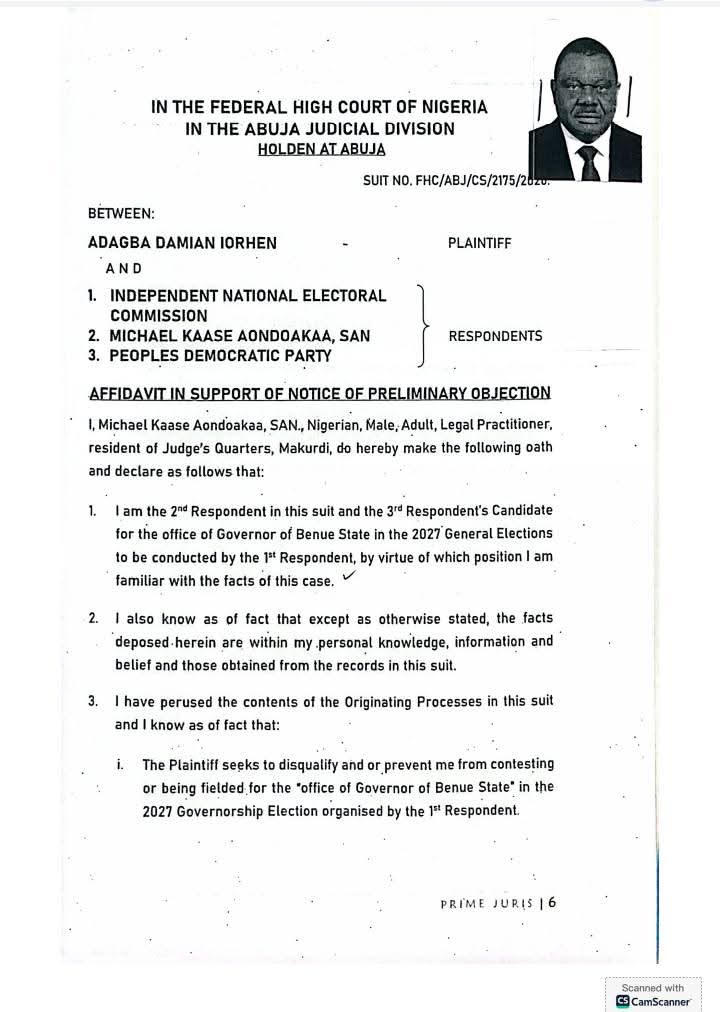
Aondoakaa, who is the governorship candidate of the Peoples Democratic Party (PDP) in the 2027 election, made the request in a preliminary objection filed in Suit No. FHC/ABJ/CS/2175/2026 instituted by the governorship candidate of the Allied Peoples’ Movement (APM), Hon. Adagba Damian Iorhen against the Independent National Electoral Commission (INEC), Aondoakaa and the PDP.
The plaintiff is seeking, among other reliefs, an order disqualifying or preventing Aondoakaa from contesting the governorship election.
However, in the preliminary objection and accompanying written address, Aondoakaa urged the court to dismiss the suit in limine, arguing that the plaintiff commenced the action outside the mandatory 14-day period prescribed for pre-election matters.
According to him, his emergence as the PDP governorship candidate was publicly known after he won the party’s primary election on May 24, 2026, while his Certificate of Return was presented on June 24, 2026 and his name subsequently forwarded to INEC.
He argued that the plaintiff’s suit, filed on September 11, 2026, was instituted well outside the constitutionally prescribed period.
Aondoakaa’s legal team maintained that Section 285(9) of the 1999 Constitution, as amended, requires every pre-election matter to be filed not later than 14 days from the occurrence of the event, decision or action complained of.
The former minister further contended that the issues raised by the plaintiff were pre-election matters relating to his qualification or disqualification and were therefore subject to the constitutional time limit.
He also argued that the plaintiff lacked the locus standi to challenge his emergence as the PDP candidate, claiming that the plaintiff was neither a member of the PDP nor an aspirant who participated in the party’s governorship primary that produced him.
The objection stated that the plaintiff allegedly became a member and governorship candidate of the Allied Peoples’ Movement (APM) on September 11, 2026, months after the PDP primary had been conducted.
Aondoakaa further argued that the grounds for qualification and disqualification for the office of governor are constitutionally prescribed under Sections 177 and 182 of the 1999 Constitution and could not be expanded through judicial interpretation.
He specifically denied being disqualified under any of the constitutional provisions, stating that he was not under a death sentence, had not been declared a lunatic, was not an undischarged bankrupt and had not been convicted of an offence involving dishonesty.
He also rejected the plaintiff’s reliance on a previous Supreme Court case, SC 939/2015, involving Aondoakaa and Emmanuel Obot, arguing that the case was civil and did not amount to a criminal conviction.
According to him, he was neither arraigned nor convicted for a criminal offence in the case and was therefore not caught by the constitutional provisions relating to criminal conviction and disqualification.
The former minister’s lawyers also challenged the procedure adopted by the plaintiff, arguing that an originating summons was not the appropriate process for enforcing a judgment.
They contended that where a party seeks to enforce a subsisting judgment, the appropriate procedure provided by law must be followed and that a person who was not a party to the original proceedings could not, in the circumstances alleged, seek to enforce the judgment.
The defence further alleged that the originating process was defective because it was not properly signed and sealed by the Registrar of the court, arguing that compliance with the prescribed procedure was a condition precedent to the competence of the action.
Citing a number of Supreme Court and Court of Appeal decisions, including Madukolu & Ors v. Nkemdilim, APC v. Umar, Marwa v. Nyako, PDP v. INEC, Karshi & Ors v. Gwagwa & Ors and Wada & Ors v. Bello & Ors, the legal team urged the court to resolve the preliminary objection in favour of Aondoakaa.
The respondents maintained that the plaintiff’s claims were speculative, incompetent and disclosed no reasonable cause of action against Aondoakaa.
They consequently asked the Federal High Court to dismiss or strike out the suit for want of jurisdiction, lack of locus standi, absence of a reasonable cause of action, non-compliance with the applicable rules and alleged abuse of court process.
The court is expected to determine the preliminary objection before proceeding to consider the substantive claims, subject to further proceedings in the case.